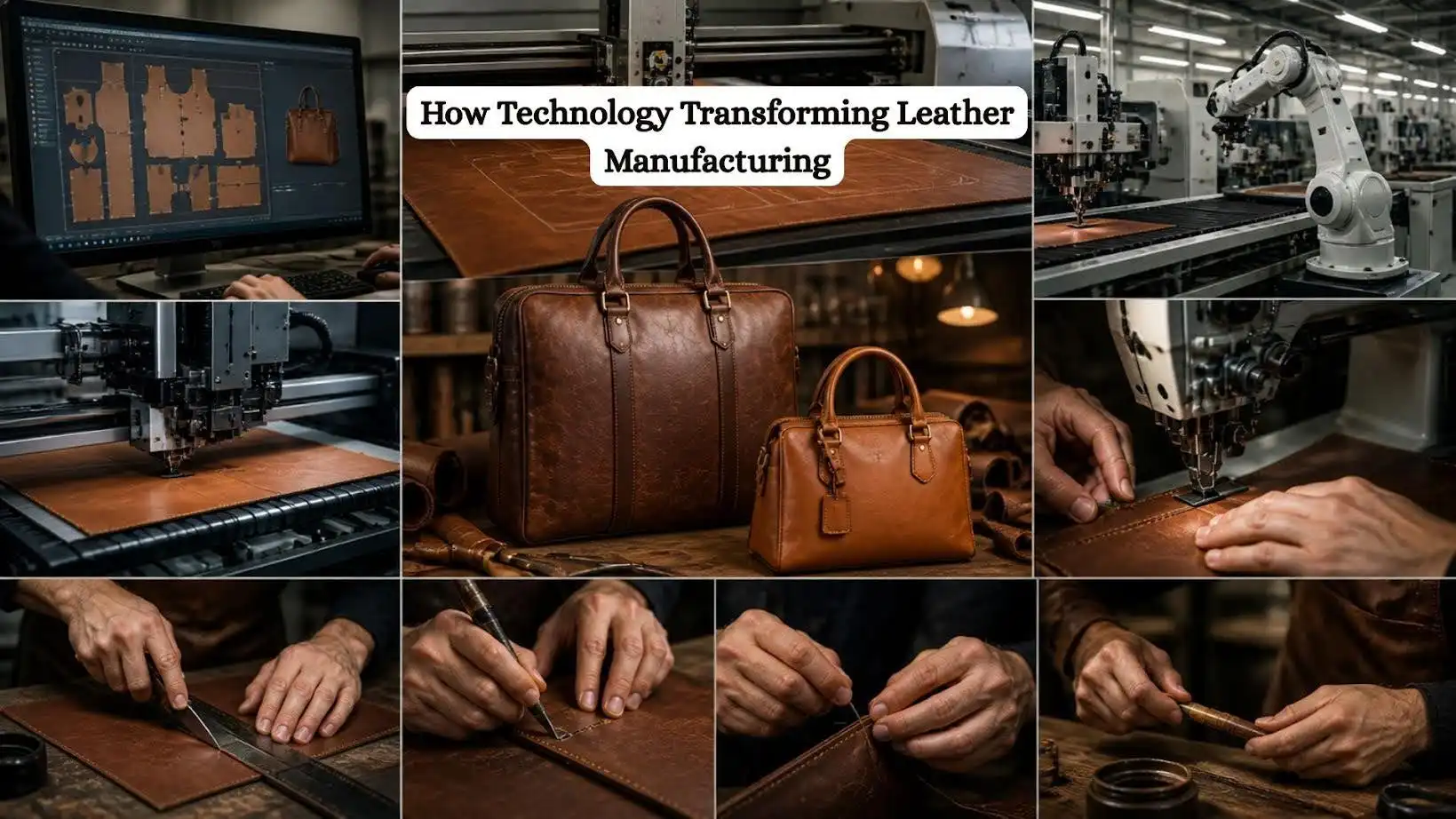
The leather industry is going through a significant transformation as technology becomes more deeply integrated into production. Processes that were once entirely manual and dependent on individual craftsmanship are now supported by advanced machinery and automated workflows. Today, technology in leather manufacturing is not just about increasing speed but also about improving consistency and precision.
Leather manufacturers are under pressure to deliver reliable quality within shorter timelines as global demand for leather goods continues to grow. From digital pattern development to automated cutting and finishing, the leather manufacturing process is becoming more structured and efficient.
This article explores how these changes are shaping modern leather production and influencing the future of the industry.
Key Challenges Faced in Traditional Leather Manufacturing
Traditional production methods presented several challenges that affected both output and product quality. Since leather is a natural material, variations in texture, grain, and thickness made it difficult to maintain uniformity. Manual handling at every stage increased the likelihood of inconsistencies and errors. At the same time, scaling production without affecting quality was a constant challenge.
Some of the most common issues included:
- Inconsistent quality due to manual intervention
- Higher levels of material wastage
- Limited ability to scale production efficiently
- Dependence on skilled labor at every stage
- Difficulty maintaining uniform standards across batches
These limitations highlighted the need for a more structured and reliable approach, leading to the integration of technology in leather manufacturing.
Role of Technology in Leather Manufacturing to Transform the Process
Technology has reshaped the leather manufacturing process by introducing greater control, efficiency and consistency across every stage of production.
-
Automation in Leather Processing
The introduction of automation in leather processing has brought noticeable improvements in both accuracy and productivity. Automated cutting systems use digital patterns to optimize material usage. This helps to reduce waste while maintaining precision. Stitching and assembly processes are also supported by advanced machinery, ensuring consistent results across large production runs. As a result, production becomes more predictable, allowing manufacturers to meet tight deadlines without compromising on quality.
-
Impact of Automation on Leather Production
The impact of automation on leather production is reflected in improved efficiency and consistent output. Automated systems ensure that each product follows the same specifications, reducing variation between batches. This level of consistency is particularly important for brands that require uniform quality at large scale. Automation also improves resource utilisation by optimising labor and materials. Skilled workers can focus on specialised tasks, while machines handle repetitive processes.
-
Modern Leather Production and Digital Integration
Modern leather production increasingly relies on digital tools that connect different stages of manufacturing. From design software to production tracking systems, digital integration improves coordination and communication across the production environment. This connectivity ensures that designs are accurately translated into finished products, making digital integration a defining feature of efficient and reliable leather manufacturing.
-
Quality Control in Leather Manufacturing Through Technology
Technology has strengthened quality control in leather manufacturing by introducing structured and data-driven inspection methods. Automated systems can identify visible defects, while digital monitoring tools track production performance in real time. This approach allows manufacturers to detect issues early and take corrective action before they affect the final product. Consistent quality control reduces rejection rates and ensures that products meet required standards.
-
Experience and Technology: A Combined Approach
While technology plays a significant role in modern production, it is most effective when combined with human expertise. Skilled professionals oversee automated systems ensuring that processes run smoothly and adjustments are made when necessary. Experience helps interpret material variations and fine-tune production settings, something machines cannot fully achieve on their own. This combination of experience and technology creates a balanced approach, ensuring that modern leather production delivers both precision and reliability.
Benefits of Technology in Leather Industry
The benefits of technology in the leather industry extend beyond faster production. It helps create a more controlled and efficient manufacturing environment.
Key advantages include:
- Greater precision in cutting and assembly
- Reduced material wastage through optimised processes
- Faster production cycles
- Improved consistency across batches
- Better monitoring and quality control systems
These advantages enable manufacturers to deliver high-quality products while managing costs and resources more effectively.
Conclusion
Technology is transforming the leather industry by introducing greater efficiency, precision, and scalability into production processes. Modern advancements are redefining how leather goods are manufactured. While traditional methods laid the foundation, technology has enabled the industry to meet the demands of today’s market more effectively. This balance ensures that efficiency does not come at the cost of quality. As the industry continues to evolve, technology in leather manufacturing will remain a key driver of innovation, shaping the future of modern leather production.
FAQs
-
How is technology used in leather manufacturing?
It is used in automation, digital design, quality control, and process optimisation.
-
What are the benefits of automation in leather processing?
Automation improves efficiency, reduces errors, and enhances material utilisation.
-
Does technology replace craftsmanship in leather manufacturing?
No, it supports craftsmanship by improving precision and consistency.
-
What is the future of leather manufacturing?
It involves advanced automation, sustainability, and digital integration.